When having an existential crisis, say, the day after you graduate from college, it is important to distract yourself with something that gives you reason and purpose. When I left Sanford Stadium on the night of May 5th, I walked into a week-and-a-half break between 18 years of academic learning and the first day of my big-girl job. As an adult with ADHD, a vacation like this is fun for about one day, after which the surplus of free time becomes a source of anxiety. I thrive under a structured life and a repetitive, predictive schedule. When I have no schedule, items on my to-do list bounce around in my brain until I’m overwhelmed and have either completed each task halfway or have not moved from the bed by 5PM. In this case, I decided to silence the hoard of bees in my head by turning all of my attention to my vegetative children. Having plants is fun, but what is more fun? Having more plants! Since my last post (16 days ago) I have acquired 30 plants.
…Step 1 is admitting you have a problem, right?
If you have plants, you know that proper care of them takes a lot of time. They exist in a separate temporal dimension from us and grow much s l o w e r than what we are accustomed to. They are sneaky though – you’ll spend an hour one morning checking on everyone’s water levels, see that everything’s hunky-dory and go overnight at someone else’s house, then come home to an extremely droopy nerve plant that has the gall to drink the water you finally give it s o s l o w l y . But trouble as they are, we love our photosynthetic kiddos, which is why few can resist the section of cute $4 plants at Home Depot and Lowe’s. I… am definitely not one of those few. I cannot help myself to 3 (or 7) little plants when I walk by on my way to grabbing the bag of dirt or pebbles that I came for. As a result, my kitchen table has been entirely covered with new plants for the last week. I think I’ve been in denial about how little space I have to display them, justifying my impulse purchases with an optimistic, “we’ll find a place or we’ll make one!” It’s also difficult to find issue with the “plant bug” when you think about how they clean your air and help your depression with their cheery colors. It was a coping mechanism, however, and I’m now realizing it may not have been the healthiest.
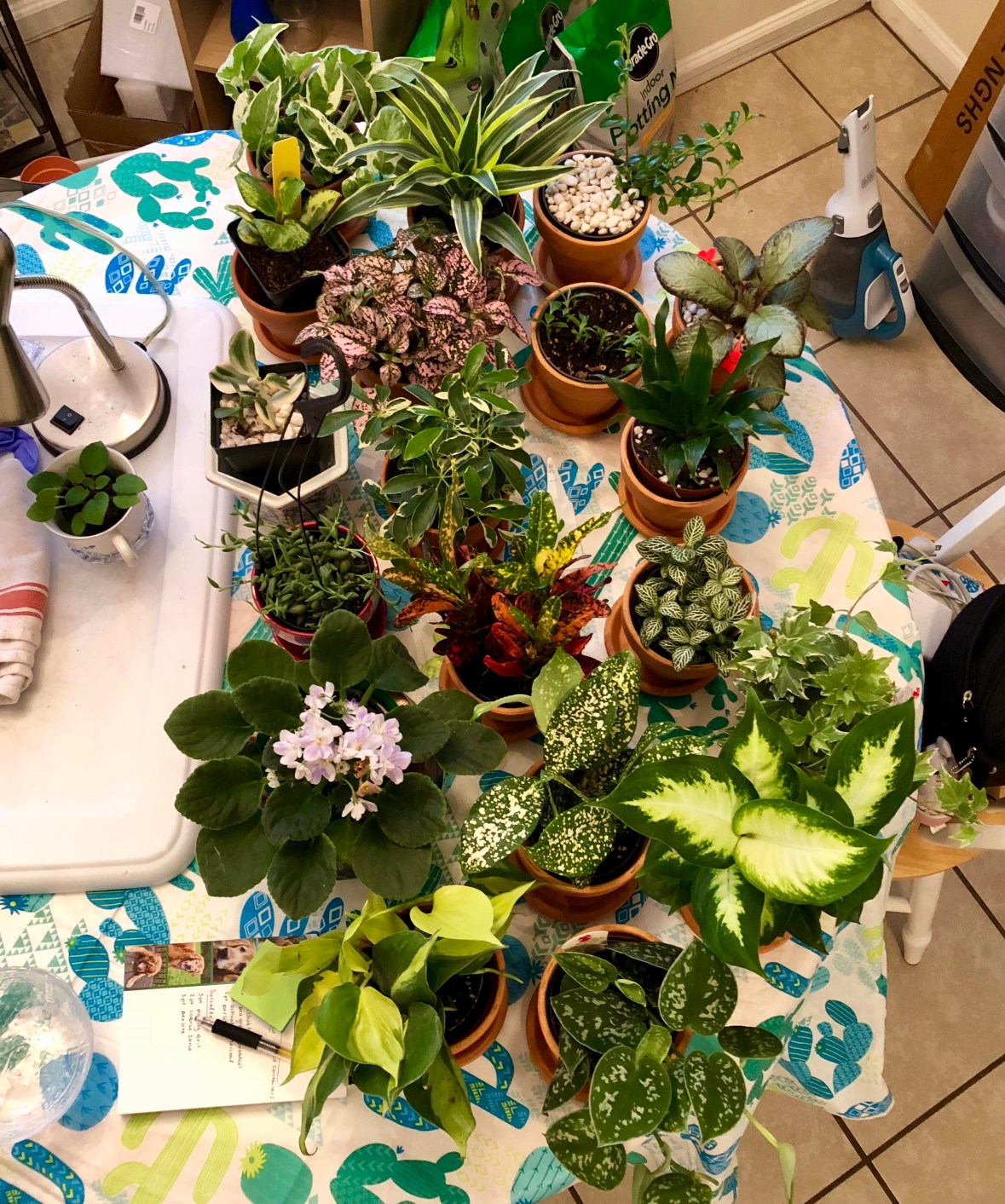
These are all relatively new plants that are waiting to move from plastic grower’s pots to more permanent clay pots. I acquired 5 plants after this photo was taken.
Buying and taking care of all those plants in such a short amount of time kept me busy and my brain away from all the immobilizing thoughts that surge when my hands and body are idle. I love taking care of and looking at my plants and, with my detail-oriented mind, I can get sucked into gardening at the kitchen table for HOURS. I’m like my lazy cat: when my roommates go to dinner, I’m sitting at the kitchen table pruning African violets. When my roommates come home, I’m still sitting at the kitchen table, hands wrist-deep in a bowl of dirt. The sun’s gone down, my back is aching, but it’s just so hard to put the miniature shovel down. I don’t know why I’m so incredibly stuck to my plants and it’s not clear whether I should by concerned about the mental effects they have on me. On one hand, living in a space full of lively, colorful beings brightens my mood immensely. It also gives me responsibility, a highly helpful and underrated thing for many people struggling with mental health. But at the same time, walking into the kitchen to see 50 plants that need my attention can be a source of anxiety as well.
I do this thing where if I’m home alone for an extended period of time, I don’t eat. I forget to feed myself unless there’s someone else home who also needs to be fed. I also learned this past weekend (Alex went to see his family for Mother’s Day) that when I’m home alone AND I don’t have a schedule, I basically break down and cannot function normally. The house got messy from all my half-completed chores and the disorganized chaos of clean clothes on the floor and plants on every surface in the kitchen got me so stressed out that I just denied it and kept working on my plants. I went to bed at 5 AM the first night that Alex was gone, knowing full well that I was meeting my parents (an hour away) for lunch the next day. When Alex got back, the house was wrecked and I had been impulsively consuming everything I could find that contained chocolate.
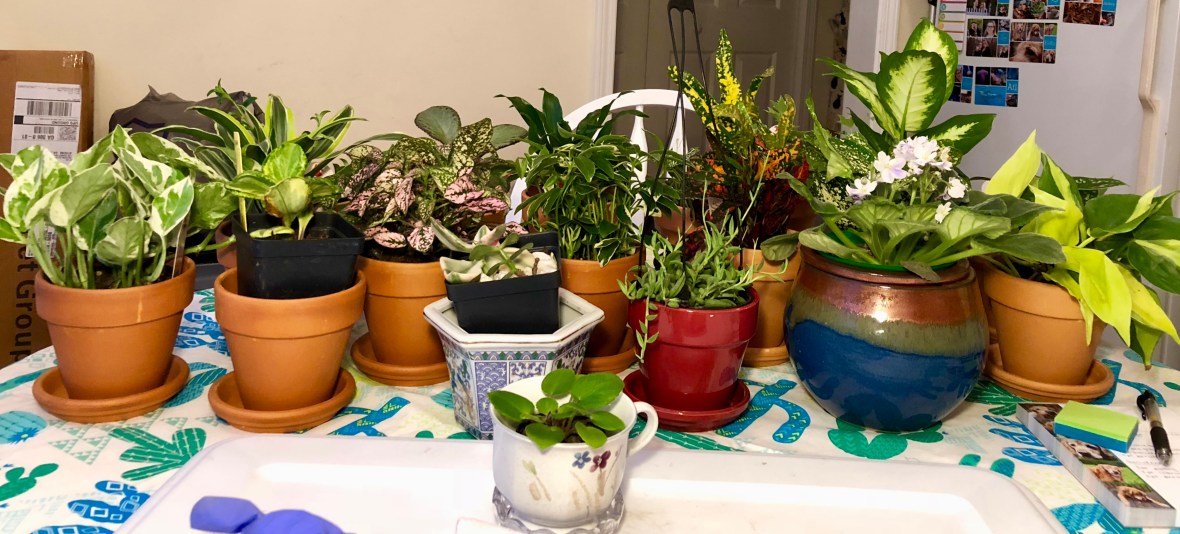
My new friends.
Adults with ADHD can experience impulsiveness that is difficult to control (like buying too many plants). People with anxiety often seek relief from the constant worry and fear and engulf themselves in sanctuary when they find it (my sanctuary is plants); they also look for hobbies and activities to keep their busy minds occupied (again, plants). People with depression tend to think that no matter what they do, they will continue to be worthless. When they find something that they feel gives them worth, it can alleviate some of the weight of their depression, and they hold onto it (every new leaf or bud I find tells me that I’ve made that plant happy, and that makes me happy). To some introverts, a little socialization is necessary, but prolonged exposure to other people is close to unbearable (plants are alive – mine are my friends). Everyone deals with these challenges differently based on what works for them. I guess I shouldn’t be surprised that I’m so drawn to my ever-expanding collection of flora.
~~~~~
Today was my second day back to work and a schedule, and I am feeling SO much better and in control than I have been for the last two weeks. I’ve always feared growing up and having to work a job for the rest of my life, but this vacation into mental chaos has shown me that adulthood is going to be just fine.
Until the next time I am able to finish one of my 14 draft posts,
Amy
 Plant Sense